
Cities need more green space. But public land is limited, budgets are tight, and trees take time to grow. For forest departments, municipal bodies and public agencies, the challenge is to create real green cover, quickly and at a reasonable cost.
A dense native forest is one way to do it, and the Bharat Vann method is designed with this in mind.
The problem with usual plantations
Planting a row of trees along a road is useful, but it gives limited benefits. Trees spaced far apart take years to fill in. Weeds grow between them. Many saplings die when watering stops. The area stays thin and fragile.
What a dense native forest offers
- Fast filling-in. Dense, layered planting closes the canopy quickly.
- Less weeding. Shade stops weeds from growing.
- Many benefits in little space. Cooler air, trapped dust, shelter for wildlife and better soil in a small area.
- Lower long-term care. After the early years, a dense forest looks after itself more.
Why Bharat Vann for public land
Public land is often poor land: compacted, dry, full of debris or salty. Bharat Vann puts soil first, using natural ingredients such as cow dung, compost and jeevamrut. It is adjusted for Indian climate and conditions. And it is labour-centric, so it creates local jobs while the forest grows.
Recognised by the Delhi Forest Department
Bharat Vann is now being implemented in a project undertaken for the Delhi Forest Department, which also recognises this adapted dense plantation method under the name Bharat Vann. It is a sign that the method meets practical government forestry needs.
Where it can work
- Unused plots owned by the municipality or the state
- Land along roads, railway lines and canals
- Government school and college grounds
- Land around public buildings, hospitals and offices
- Degraded or barren land inside city limits
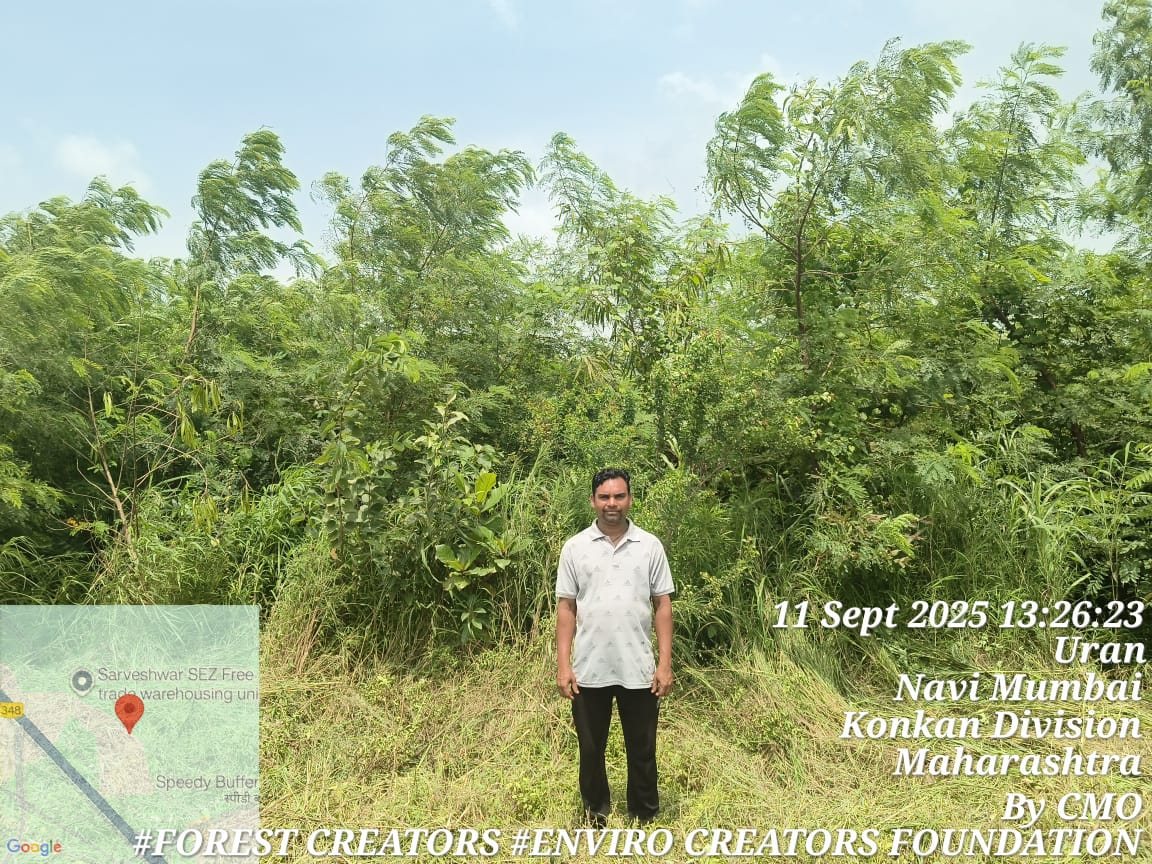
- Industrial and port land, such as the SEZ at JNPT
What a project looks like
- Site survey and soil study
- Soil preparation and natural enrichment
- Selection of native species
- Dense, layered planting by local workers
- Mulching and irrigation
- Monitoring, reporting and care in the early years
Working with local communities
When local people plant a forest, they feel it belongs to them. Schools can visit. Residents can help with watering. A public forest becomes a community space, not just a patch of green on a map.
Reporting that officials can trust
Government projects need clear records. Photographs with date and location, survival counts and regular site updates make it simple to show progress. Our site photographs at JNPT, for example, carry location and date stamps.
Frequently asked questions
Can Bharat Vann work on small public plots?
Yes. Dense planting works well on small plots, which makes it useful in cities.
How is it different from normal plantation?
Trees are planted close together, in layers, with enriched soil, so the forest fills in faster and needs less care over time.
Do you offer turnkey projects?
Yes. We handle planning, planting and early care.
Responsible for public land or green cover? Talk to Forest Creators about a Bharat Vann project.
Talk to Forest Creators